Pools#
- Pools are a little bit like the pot in Poker
- You lock player’s money in a pot (pool) and you play it
- The same is with Polymarket and Fantasy football—you lock the money, and you wait for things to happen, and when they happen, you let the rules of the game (contracts) distribute the pot
- In the case of DeFi, we are dealing with pools of tokens (ETH, DAI, USDC, etc.)
Pool Farming#
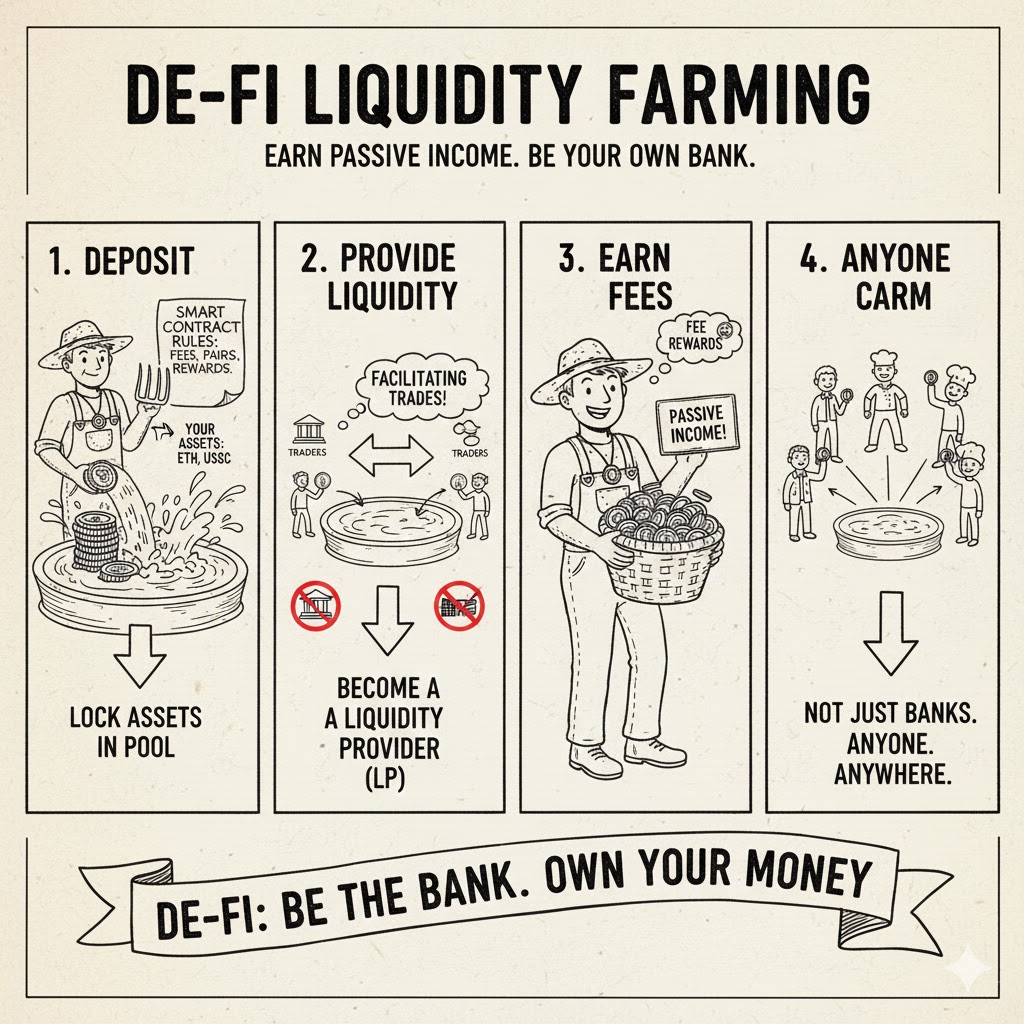
- In De-Fi, pool farming is a form of passive income—meaning you put your money somewhere, and it gives you returns
- Specifically - much like with airport currency exchanges—you can lock your money in a digital currency trading pool (ran by someone else), and they will pay you a fee each time a transaction is made
- In this case you act as a liquidity provider
- This is really important to understand…in real finance, only financial institutions (mostly big banks or governments) are as liquidity providers
- In De-Fi it can be anyone
What Are Liquidity Pools?#
Liquidity pools are a core building block of Decentralized Finance (DeFi), especially on platforms like Uniswap or other Automated Market Makers (AMMs). Think of them as shared “pots” of cryptocurrency tokens that anyone can contribute to or draw from, enabling seamless trading without needing a traditional middleman like a stock exchange. Instead of buyers and sellers matching orders (like on eBay), liquidity pools use smart contracts—self-executing code on blockchains like Ethereum—to automate trades based on math. This makes DeFi fast, open, and borderless, but it also introduces some unique risks and rewards.
How Do Liquidity Pools Work?#
The Setup: A liquidity pool typically holds two (or more) tokens in equal value, say ETH and USDC (a stablecoin pegged to the U.S. dollar). Users called liquidity providers (LPs) deposit these tokens into the pool. For example, you might add $500 worth of ETH and $500 worth of USDC, creating a balanced reserve.
The Magic Math (AMM Formula): The pool maintains balance using the constant product formula: ( x \times y = k ), where:
- ( x ) is the amount of the first token (e.g., ETH).
- ( y ) is the amount of the second token (e.g., USDC).
- ( k ) is a constant number that never changes.
If someone wants to swap 1 ETH for USDC, the smart contract calculates how much USDC to give out to keep ( k ) the same. This automatically adjusts prices based on supply and demand—more trades in one direction make that token scarcer and pricier. It’s like a vending machine that restocks itself dynamically!
- Trading and Fees: Traders pull liquidity from the pool (e.g., swapping ETH for USDC), and the pool rebalances. LPs earn a small fee (often 0.3%) on every trade, proportional to their share of the pool. If the pool has $1 million total, and you provided $1,000, you get 0.1% of all fees—passive income!
Why Use Liquidity Pools? (The DeFi Perks)#
- Decentralization: No bank or broker controls it; it’s run by code on the blockchain, open to anyone with an internet connection.
- Efficiency: Instant trades 24/7, even for niche tokens, without waiting for a counterparty.
- Yield Opportunities: In tools like DeFi Scholar, you could simulate this by “providing liquidity” to a virtual pool with scholar tokens, earning rewards while learning how real-world yields (like from Aave) compound over time.
The Risks (And How to Spot Them)#
Liquidity pools aren’t risk-free— that’s where the education shines:
- Impermanent Loss: If token prices shift a lot (e.g., ETH moons while USDC stays flat), your pooled assets might be worth less than if you’d just held them separately. It’s “impermanent” because it only “locks in” if you withdraw during the imbalance.
- Smart Contract Bugs: Code can have flaws, leading to hacks (though audited pools like Uniswap minimize this).
- Volatility: Pools amplify market swings, teaching behavioral economics—like how a “crash” simulation in DeFi Scholar could wipe out gains if you’re overexposed.
What is Yield Farming?#
Yield farming is an advanced DeFi strategy where users “farm” rewards by providing liquidity to decentralized protocols, essentially lending out their crypto assets to earn high yields—often much higher than traditional savings accounts. It’s like planting seeds (your tokens) in a garden (liquidity pools) and harvesting crops (rewards) over time, but with the potential for rapid growth or weeds (risks). As of 2025, with DeFi’s total value locked (TVL) surging due to RWA tokenization and AI-driven optimizations, yield farming remains a cornerstone for passive income, simulating real-world economics like supply/demand dynamics in automated market makers (AMMs).
In the DeFi Scholar platform, yield farming is gamified through quests like “Optimize your APY to beat inflation,” where you use virtual scholar tokens to farm yields, compounding rewards based on real Aave-like rates from APIs—teaching behavioral economics without real crypto exposure.
How Yield Farming Works (Step-by-Step)#
Yield farming builds on basics like staking (locking tokens for network security) but focuses on liquidity provision for trading pairs. Here’s the core process:
Deposit Liquidity into Pools: Connect a wallet (e.g., MetaMask) to a DeFi platform like Uniswap or Curve. Add equal values of two tokens (e.g., ETH and USDC) to a liquidity pool—a smart contract that facilitates trades via AMM math (constant product formula: x * y = k, where x and y are token reserves). In return, you get LP (liquidity provider) tokens representing your share.
Earn Base Rewards: Protocols reward LPs with a cut of trading fees (e.g., 0.3% per swap on Uniswap) plus governance tokens (e.g., UNI or CRV) to incentivize participation. This is “liquidity mining.”
Stake LP Tokens for Extra Yields: To amp it up, stake those LP tokens in a farming vault on platforms like Yearn.finance or Beefy. Here, you earn additional token rewards, often with compounding (reinvesting automatically for exponential growth).
Optimize and Harvest: Monitor APY (annual percentage yield, which can hit 10-50%+ in 2025 for volatile pairs but fluctuates wildly). Harvest rewards periodically, swap them for more base assets, and redeposit to compound. Tools like Zapper or DeFiLlama help track multi-protocol strategies.
Withdraw: Unstake and remove liquidity anytime (though fees or slippage may apply). In liquid staking variants (e.g., via Pendle), you can trade future yields without locking up.
| Strategy | Description | Example 2025 APY (Est.) | DeFi Scholar Tie-In |
|---|---|---|---|
| Single-Sided Staking | Stake one token in a pool (e.g., stablecoins only). | 5-15% (e.g., USDC on Aave) | Basic virtual staking module for compounding interest. |
| LP Farming | Provide paired liquidity + stake LPs. | 20-100% (e.g., ETH/BTC on SushiSwap) | Simulate AMM math (x*y=k) with scholar tokens. |
| Cross-Chain Yield | Farm across networks (e.g., Ethereum to Solana via bridges). | 30-80% (with RWA boosts) | Capstone workflow: Collateralized lending across simulated networks. |
| Leveraged Farming | Borrow to amplify deposits (high risk). | 50%+ (but volatile) | Risk education via “market crash” simulations showing liquidation. |
Why Farm Yields? Benefits in 2025#
- High Returns: APYs often outpace inflation or TradFi (e.g., 8-12% base on stables, spiking during bull runs).
- Compounding Power: Reinvest rewards to grow exponentially—e.g., start with $1,000 at 20% APY, compound monthly, and hit ~$1,220 in a year.
- Accessibility: No KYC needed; start with $100 on testnets. 2025 trends like AI oracles (e.g., Chainlink) auto-optimize strategies.
- Educational Edge: In DeFi Scholar, it ties into economics via Sharpe ratio scoring in tournaments, showing risk-adjusted returns.
Key Risks (Don’t Skip These!)#
Yield farming isn’t free money—it’s high-reward, high-risk:
- Impermanent Loss: If token prices diverge (e.g., ETH moons while USDC stays flat), your pool share loses value vs. just holding.
- Smart Contract Vulnerabilities: Hacks can drain pools (e.g., $600M Ronin exploit in past; audit tools like Certik help spot red flags).
- Rug Pulls/Volatility: New tokens can crash 90% overnight; gas fees eat small farms.
- Regulatory Hurdles: As a teen in DeFi Scholar, simulations avoid these, but real farming may trigger taxes or regs—emphasize education first.