Blockchain Basics: Intro and Concepts#
- We will start with simple examples to introduce the technology and the way it works
- Then we’ll explain what the important concepts are – what makes the technology so powerful
- …and only then we’ll get into complex stuff required to understand what goes on under the hood
Consider an example:
You have a regular account in a bank (like Chase) and Venmo app. A friend is asking you to pay him in Bitcoin. How would this work?
Wallets#
- Remember how Bitcoin is a network?
- All the kids with their Venmo apps are now nodes in that network
- Specifically, these nodes are known as digital wallets
- Wallets are a lot like bank accounts
- You keep your money (digital currency, tokens) in them
- You send/receive tokens from/into them
- The network knows the wallets by their IDs (just a long text string)
A Word on Exchanges#
- In real markets and cryptocurrency markets, exchanges are companies that perform buying and selling of stocks or currencies
- If you saw a “Currency Exchange” kiosk at an airport – that’s a little exchange
- It holds cash in many currencies
- It buys currency from you at a lower rate and then sells it to someone else at a higher rate and makes profit
- Stock markets do this as well, just at a much higher scale
Buying Bitcoin into Venmo#
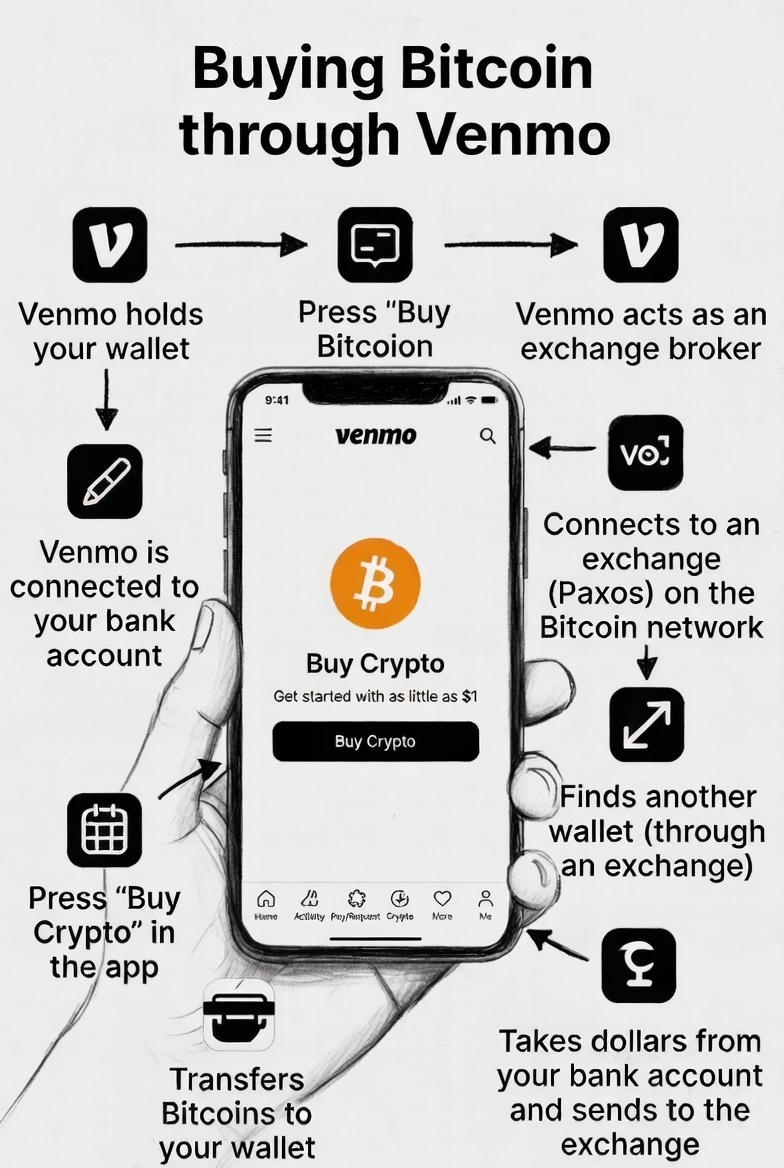
- Venmo holds your wallet and Venmo is connected to your bank account
- Venmo also acts as an exchange broker
- The first thing you do in the app is press “Buy Crypto”
- …and then Venmo will do the following:
- Connect to one of many exchanges operating in the Bitcoin network (Paxos)
- Conduct the transaction on your behalf
- Find another wallet (through an exchange) that transfers its Bitcoins to your wallet
- Take some dollars from your bank account and send to that exchange (which will later send it to whoever > sold bitcoins to you)
Can It Be Done Differently?#
- Yes, it can
- When cryptocurrencies just started, people used USB-sticks with their digital wallets and had to know their counterparties (people to sell to or buy from)
- Knowing a counterparty is knowing their wallet’s network address
- This was a pure peer-to-peer setup – no exchanges, no banks
- It guaranteed anonymity, which is helpful for all kinds of shady activity
- The only information that was public is that a wallet with ID1 moved some coins to a wallet with ID2
- This option is still available, but most people use bank-linked apps and trade through exchanges – because it is much easier than going hard-core
- Digital wallets managed by services like Venmo or other digital currency exchanges are called “custodial” wallets – meaning someone has custody of your stuff
Summary#
- Blockchain is a P2P network technology
- Bitcoin is just one of many blockchain networks
- Nodes are digital wallets
- In the “pure” model, it is a decentralized anonymous system
- In reality, most people use centrally owned services (banks, apps, exchanges) to transact in Bitcoin